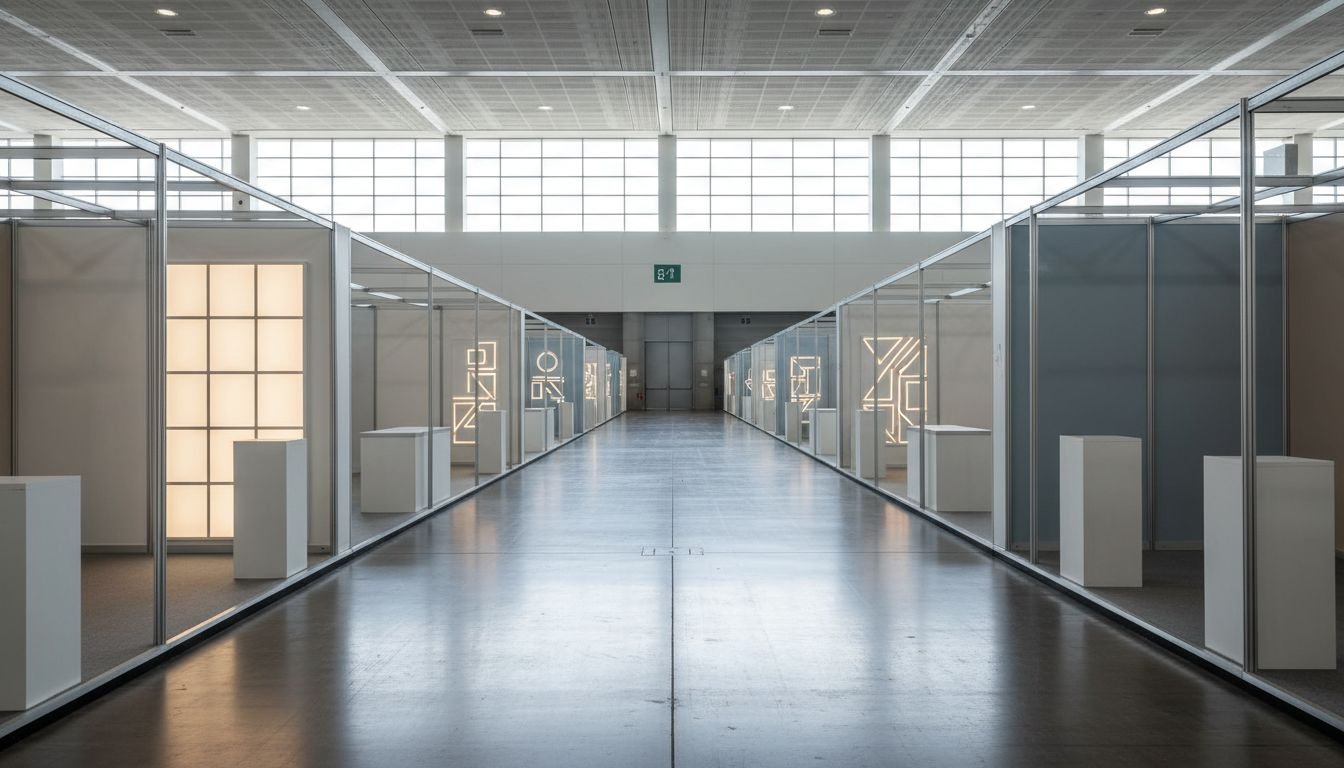

Can I Work at a Trade Show or Expo on a Visitor Visa?
You can attend a trade show in Australia on a Subclass 600 visa in the Business Visitor stream. You generally cannot work at one. The difference sounds small, and it catches out a surprising number of experienced business people every year. The line is drawn by two pieces of law: the definition of “business visitor activity” in the Migration Regulations, and condition 8115, which is attached to every Business Visitor stream visa that Home Affairs grants.
This article is for anyone travelling to an Australian expo, conference or trade fair, and for the Australian businesses inviting them. We look at what the regulations actually say, walk through the situations that cause the most trouble on an exhibition floor, and explain what happens if a case officer decides you crossed the line.
The two rules that decide everything
Almost every question about trade shows and visitor visas comes back to two provisions.
The first is condition 8115. It is short, and it is imposed on every Subclass 600 visa granted in the Business Visitor stream:
The holder must not work in Australia other than by engaging in a business visitor activity.
That wording comes from Schedule 8 of the Migration Regulations 1994. Clause 600.613 of Schedule 2 makes conditions 8115 and 8201 mandatory for this stream, so there is no version of the Business Visitor stream that arrives without it.
The second is the definition of a business visitor activity in regulation 1.03. This is the part most people have never read, and it is where the answers actually live:
(a) means any of the following activities undertaken by a person:
(i) making a general business or employment enquiry;
(ii) investigating, negotiating, entering into, or reviewing a business contract;
(iii) an activity carried out as part of an official government to government visit;
(iv) participation in a conference, trade fair or seminar in Australia unless the person is being paid by an organiser for participation; but
(b) does not include either of the following activities:
(i) an activity that is, or includes, undertaking work for, or supplying services to, an organisation or other person based in Australia;
(ii) an activity that is, or includes, the sale of goods or services directly to the general public.
Read paragraph (a)(iv) again. Participation in a trade fair is expressly on the permitted list. That is the good news, and it is why the vast majority of expo travel is perfectly lawful. The trouble starts with the exceptions.
The definition of “work” is narrower than you think
Here is the detail that trips people up. Regulation 1.03 defines work this way:
work means an activity that, in Australia, normally attracts remuneration.
Notice what that test does not ask. It does not ask whether you were paid. It does not ask whether your employer was paid. It asks whether the activity you performed is the kind of activity that normally attracts payment in Australia.
So the honest answer of “I did it for free, as a favour” does not resolve the question. If a job would normally be done in Australia by someone who gets paid for it, doing that job unpaid can still be work for migration purposes. That is a genuinely counterintuitive rule, and it is the single most common misunderstanding we see in this area.
Where the line usually falls at an expo
The regulations do not list every scenario, so these situations turn on the specific facts. What follows is how the two provisions above tend to apply in practice, not a guarantee about any particular case.
Attending as a delegate. You are there to watch presentations, walk the floor and meet people. This sits comfortably inside paragraph (a)(iv), and inside (a)(i) if you are making general business enquiries.
Meeting suppliers and negotiating terms. Expressly covered by paragraph (a)(ii). Investigating, negotiating, entering into or reviewing a business contract is a business visitor activity, and a trade fair is a normal place to do it.
Standing on your overseas employer’s stand and talking to visitors. This is usually fine when what you are doing is having business conversations, answering questions about your company and following up leads. It becomes a problem when it turns into the two things paragraph (b) rules out.
Selling to the public from the stand. Paragraph (b)(ii) removes any activity that is, or includes, the sale of goods or services directly to the general public. If members of the public can walk up and buy from you, that is outside the definition, and a Business Visitor stream visa does not cover it.
Doing work for an Australian business while you are here. Paragraph (b)(i) removes any activity that is, or includes, undertaking work for, or supplying services to, an organisation or other person based in Australia. The regulation even includes a worked example on this point, which is unusual and tells you the drafters expected the confusion:
Note: An example for paragraph (b) is making a general business enquiry of an organisation based in Australia and also undertaking work for the organisation as part of investigating a business opportunity.
In other words, a permitted activity does not launder an unpermitted one. Doing both means the exception bites.
Being paid by the organiser to appear. Paragraph (a)(iv) covers participation in a conference, trade fair or seminar “unless the person is being paid by an organiser for participation”. A paid keynote, a paid demonstration slot or a fee for appearing takes you outside the permitted activity. Home Affairs puts the same point plainly on its Business Visitor stream page: you can take part in a conference, trade fair or seminar, and “The organisers can’t pay you to take part.”
Installing, demonstrating or servicing equipment. This is the grey zone that most often needs advice before travel. Ask the regulation 1.03 question honestly. Is this an activity that normally attracts remuneration in Australia? Rigging a stand, calibrating machinery and running technical demonstrations are all things Australians are paid to do. That does not automatically make it prohibited, because it still has to fall outside the business visitor activity definition, but it is the point at which we would want to see the detail.
What happens if you get it wrong
Breaching a visa condition is not a paperwork issue. Under the Migration Act 1958, non-compliance with a condition is a ground on which a visa can be cancelled, and Schedule 8 carries a note pointing directly at the cancellation provisions. A cancellation while you are in Australia can also affect your ability to be granted another visa later, because your immigration history is considered in future applications.
There is a second consequence worth knowing about before you lodge. The Business Visitor stream requires you to be outside Australia both when you apply and when the decision is made. Section 338 of the Migration Act ties most visa refusal review rights to applications lodged inside Australia, so a refusal in this stream will generally not attract merits review at the Administrative Review Tribunal. There is usually no appeal to fall back on. That is why the accuracy of the first application matters so much here.
Home Affairs may also impose condition 8503 on a Business Visitor stream visa. Clause 600.613 makes it discretionary rather than automatic, but where it is imposed it prevents you being granted almost any further visa while you remain in Australia. We cover that in detail in our guide to condition 8503.
If the activity is not a business visitor activity, what is the right visa?
The answer depends on what you are actually coming to do.
For short-term, highly specialised work that cannot reasonably be sourced in Australia, the Subclass 400 is usually the visa to look at. It has its own strict tests, including that the work must be non-ongoing, and it is explained on the Home Affairs Subclass 400 page and in our guide to choosing between the 400 and the alternatives.
For performers and entertainment activity, neither the 600 nor the 400 is the right instrument, and the Subclass 408 Entertainment stream usually is.
For ongoing work with an Australian employer, you are into employer-sponsored territory rather than any short-stay visa.
If you want the general principle rather than the trade show version, we set it out in visitor visa versus work visa. For broader guidance on the 600 itself, see our Subclass 600 visitor visa guide.
Frequently asked questions
Can I hand out samples at my stand on a business visitor visa?
Handing out promotional material as part of a business conversation is different from selling. The provision to watch is paragraph (b)(ii), which excludes the sale of goods or services directly to the general public. If no sale is taking place, that exclusion is not engaged. If money changes hands at the stand, it very likely is.
I am not being paid at all. Does condition 8115 still apply?
Yes. Condition 8115 applies to the visa regardless of payment, and the definition of work in regulation 1.03 turns on whether the activity normally attracts remuneration in Australia, not on whether you personally received anything.
Can I extend my stay if the expo runs long?
No. Home Affairs states that you cannot stay longer by extending a Subclass 600. You would need to apply for a new visa, and if condition 8503 was imposed on your visa, you generally cannot be granted one while you remain in Australia.
Does my Australian host get in trouble if I do the wrong thing?
The visa condition binds you as the holder. Separately, Australian businesses have their own obligations around who they allow to work for them, and the invitation letter they write becomes evidence of what the visit was for. That is why we recommend businesses take the letter seriously rather than treating it as a formality.
A realistic next step
If your trip is purely meetings, contract discussions and attending sessions, the Business Visitor stream is very likely built for exactly what you are doing. If any part of your itinerary involves being paid by the organiser, selling to attendees, or doing something an Australian would normally be paid to do, get that specific activity assessed before you book flights. The cost of asking is small. The cost of a cancellation or a refusal with no review right is not.
If you would like your itinerary reviewed against condition 8115 before you lodge, you can book a consultation with our migration lawyers and we will look at the specific activities you have planned.
About the author: Tina Nematian is the Principal Lawyer at One Planet Migration Law. She is admitted as an Australian Legal Practitioner and is a Registered Migration Agent, and has guided clients through partner, skilled, employer-sponsored, student, and humanitarian visa applications across Australia.
Legislative references in this article were checked against the Migration Regulations 1994 and the Migration Act 1958 as in force on 3 August 2026. Visa rules change frequently. Always check immi.gov.au before lodging.
This article is general information only and does not constitute legal or migration advice. Visa rules change frequently and outcomes depend on individual circumstances. Speak with a registered migration lawyer or agent before making any application.