

 ChatGPT
 Claude
 Perplexity
 Google AI
 Copilot
 Grok
Has the points test changed in 2026?
No. As at 22 November 2026 the points test for the Subclass 189, 190 and 491 visas is still the one in Schedule 6D of the Migration Regulations 1994, and the pass mark is still 65 points under LIN 19/210. Schedule 6D was last amended by regulations that took effect on 16 November 2019. The Government has announced that it will reform the permanent migration points test, but no new points table, start date or amending regulation has been published.
We read compilation 291 of the Regulations, the latest registered compilation, in force from 3 November 2026. Three later instruments amend the Regulations, from 12 November (Training Visas), 13 November (Temporary Graduate Visa Reform) and 28 November 2026 (Preventing Further Stay for Visitor Visas). In our reading, none of them touches Schedule 6D or the invitation requirements in items 1137, 1138 and 1241 of Schedule 1.
| Item | Status as at 22 November 2026 |
|---|---|
| Pass mark and pool mark (189, 190, 491) | 65 points, for applications made on or after 16 November 2019. Law. |
| Points table | Schedule 6D, last amended from 16 November 2019. Law. |
| When points are counted | “At the time of invitation to apply for the visa”. Law. |
| Age limit | A primary applicant must not have turned 45 at the time of invitation. Law. |
| Reform of the points test | Announced in the Budget on 12 May 2026 and by the Minister on 17 September 2026. Announced, not yet law: no table, date or regulation. |
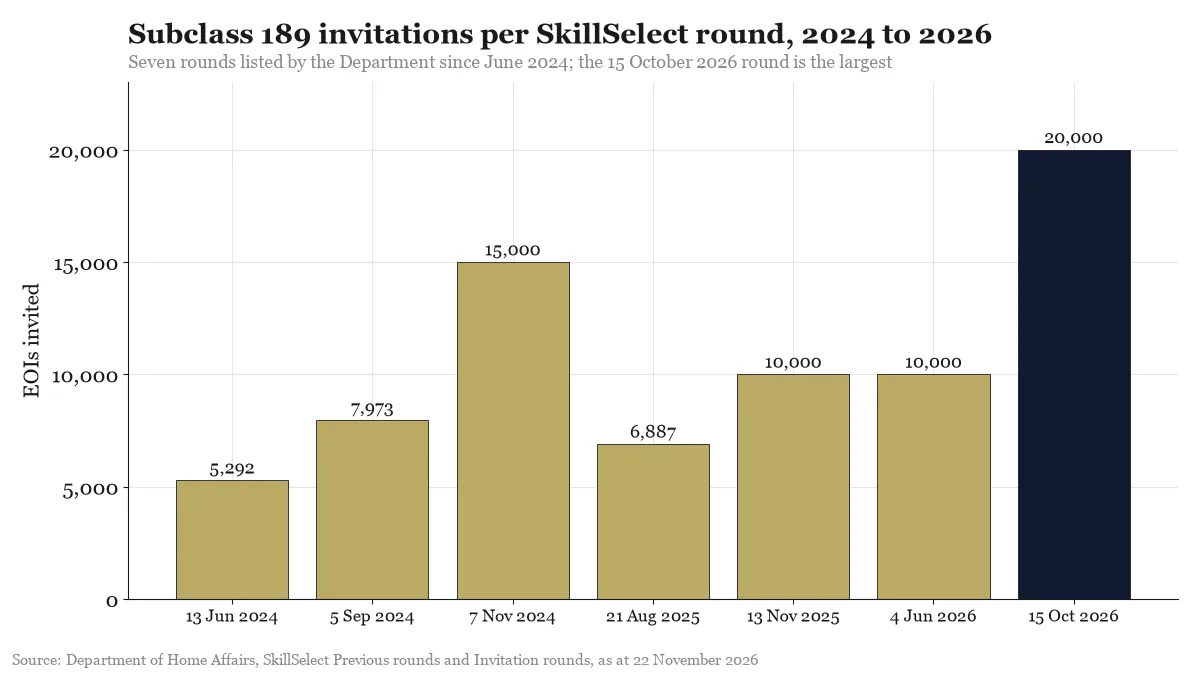
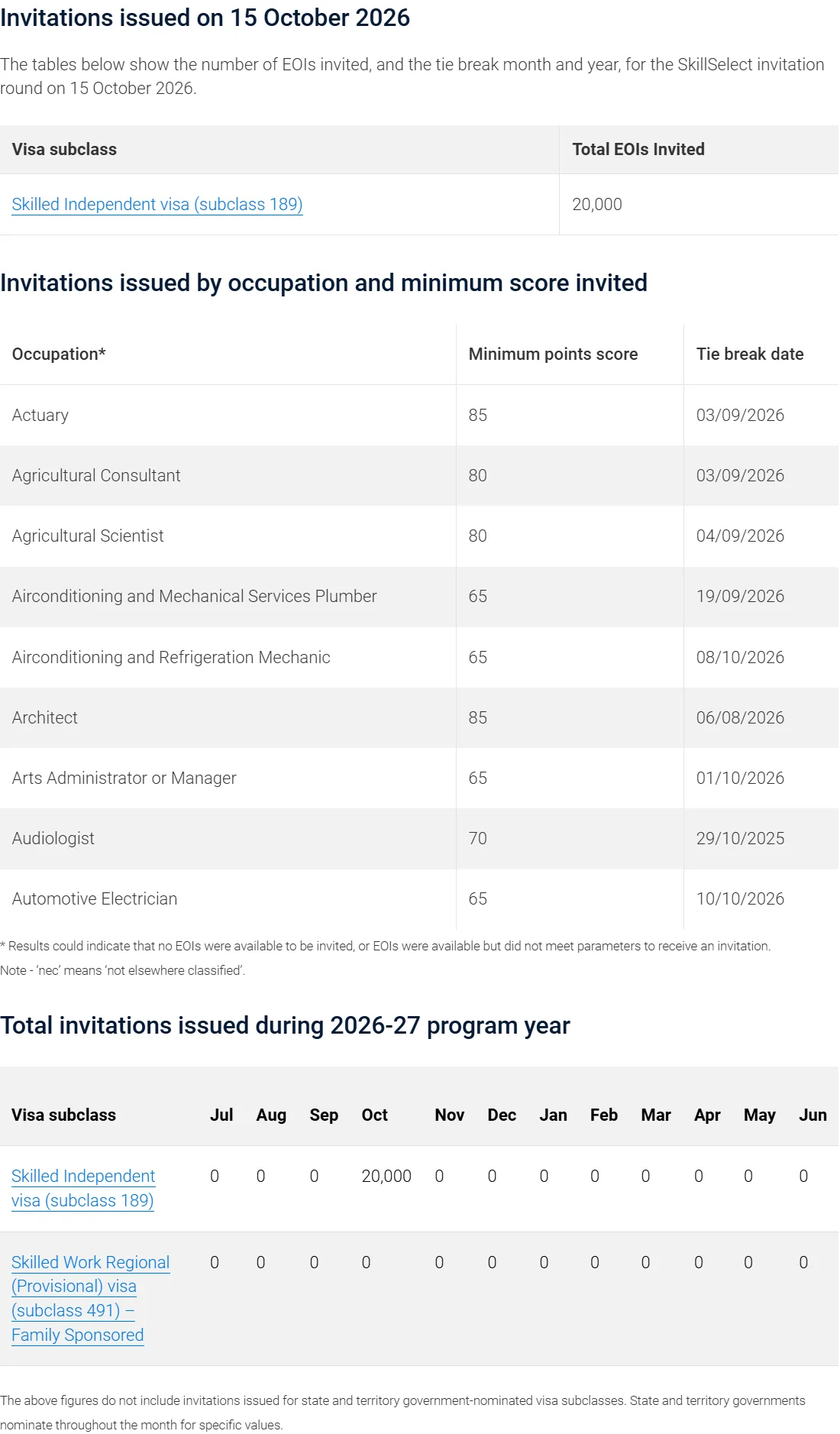
| Latest subclass 189 round listed | 15 October 2026: 20,000 invitations |
| SkillSelect moving into ImmiAccount | From 28 November 2026; unavailable 24 to 27 November. Announced by the Department on 18 November 2026. |
Source: Migration Regulations 1994, compilation 291; LIN 19/210 s 6; SkillSelect invitation rounds (updated 18 November 2026); Home Affairs news item. As at 22 November 2026.
The current points table, from Schedule 6D
Almost every item in Schedule 6D is assessed “at the time of invitation to apply for the visa”. That is the date your points are counted, which can differ from the day you lodged your Expression of Interest (EOI). The pass mark of 65 sits in a separate instrument: under section 6 of LIN 19/210, “the pool mark” and “the pass mark” are both 65 points for Subclass 189, 190 and 491 applications made on or after 16 November 2019.
| Factor (most are counted at invitation) | Points | Item |
|---|---|---|
| Age 18 to 24 | 25 | 6D11 |
| Age 25 to 32 | 30 | 6D12 |
| Age 33 to 39 | 25 | 6D13 |
| Age 40 to 44 | 15 | 6D14 |
| Proficient English / superior English | 10 / 20 | 6D22 / 6D21 |
| Skilled employment outside Australia, at least 36 / 60 / 96 months in the last 10 years | 5 / 10 / 15 | 6D31 to 6D33 |
| Skilled employment in Australia, at least 12 / 36 / 60 / 96 months in the last 10 years | 5 / 10 / 15 / 20 | 6D41 to 6D44 |
| Employment points from both lists combined | Capped at 20 | 6D51 |
| Professional Year in Australia (12 months in the last 48) | 5 | 6D61 |
| Doctorate / bachelor or higher | 20 / 15 | 6D71 / 6D72 |
| Australian diploma, Australian trade qualification, or a qualification your assessing authority recognises as suitable | 10 | 6D73 to 6D75 |
| Specialist educational qualification | 10 | 6D7A1 |
| Australian study requirement | 5 | 6D81 |
| Credentialled community language | 5 | 6D91 |
| Study in a designated regional area | 5 | 6D101 |
| Partner with skills and competent English / partner with competent English only | 10 / 5 | 6D111 / 6D113 |
| No partner, or partner who is an Australian citizen or permanent resident | 10 | 6D112 |
| Invited for a Subclass 190 visa with the nomination not withdrawn | 5 | 6D121 |
| Invited for a Subclass 491 visa, nominated or sponsored by a family member | 15 | 6D131 |
Source: Migration Regulations 1994, Schedule 6D, compilation 291 (in force from 3 November 2026), cross-checked against the Department’s Subclass 189 points table (updated 4 November 2026). Some rows are shortened; the item numbers give the full text.
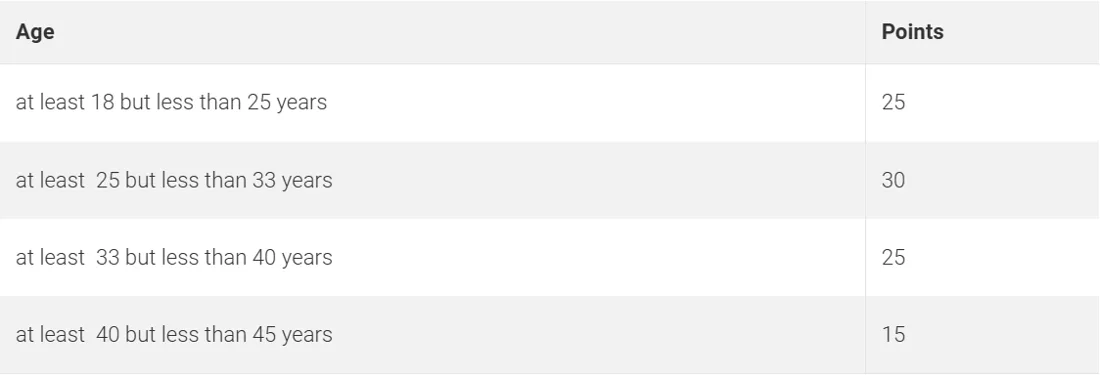
Three details change scores more often than people expect. Overseas experience stops at 15 points and Australian experience at 20, but item 6D51 caps the two together at 20. The Department’s page says you receive points for your highest qualification only. Partner points depend on the partner’s circumstances: item 6D112 gives 10 where there is no partner or the partner is an Australian citizen or permanent resident, while items 6D111 and 6D113 apply to a partner who is not.
Example (hypothetical, using the table above). Someone aged 30 at invitation (30 points) with superior English (20), a bachelor degree (15) and five years of skilled employment in Australia (15) has 80 points. If a state nominates them for a Subclass 190, item 6D121 adds 5 for 85. If they are instead invited for a Subclass 491 on a nomination, item 6D131 adds 15 for 95.
What has been announced, and what has not
The reform is real policy, but every public statement so far describes an intention. The table lists them in date order. The Department’s review page was last updated on 1 October 2026 and does not list a new points table.
| Date | Source | What it said | Status |
|---|---|---|---|
| 11 December 2023 | Migration Strategy | Listed a reformed points test as an area of future reform | Policy direction |
| 24 April 2024 | Home Affairs discussion paper | Review opened. Submissions ran from 24 April to 24 May 2024; 204 were received within scope | Consultation closed |
| 12 May 2026 | Budget Paper No. 2 | “The points test will be optimised to select better educated, higher-skilled and younger migrants overall.” | Announced, not yet law |
| 17 September 2026 | Minister for Home Affairs, National Press Club | The points test has been “redone” with Treasury; housing trades to get the same points as a university qualification “on implementation” | Announced, not yet law |
| 2 October 2026 | Assistant Minister Julian Hill, Migration Institute of Australia | The Government is “reforming the points test to lift the standard, better recognise high-demand skills” | Announced, not yet law |
Source: Home Affairs review page; Budget Paper No. 2 2026-27, page 8; Minister’s speech, 17 September 2026; Assistant Minister’s keynote, 2 October 2026. As at 22 November 2026.
The Budget paper adds: “Almost two-thirds of permanent skilled migrants are currently selected through points tested visas.” That is why the measure matters. The Minister’s own words on 17 September were that the new test adds “an unusual capacity” to choose particular skills which “will have an uplift so that they will be viewed as though they were a higher level of qualification”. His media release of the same day lists the next stage of migration policies and does not mention the points test.
What has not been published is just as relevant to planning. There is no start date, no new point values, and no list of occupations that count as housing trades. There is also no statement on whether a new test would apply to EOIs already lodged. The 2024 discussion paper asked that exact question (“Question Six: How should transition arrangements for the points test reforms work?”), and we found no later statement that answers it. The paper also asked how age points should be redesigned, pointing to “significant cliffs between ages” such as 39 to 40 (Question Three), and how partner points should work (Question Four). Those were questions, not decisions.
Claims you may have read, checked against the law
| Claim | What the sources show |
|---|---|
| The points test changed on 1 July 2026 | Schedule 6D was last amended from 16 November 2019 |
| The pass mark is going to 70 | We found no government source. The pass mark is 65 under LIN 19/210 |
| You get points for a high salary | Schedule 6D has no income item, and none appears in the 2024 paper’s questions or the 2026 statements |
| Australian study and Professional Year points have been removed | Both remain at 5 points (items 6D81 and 6D61) |
| Housing trades get university-level points | Announced on 17 September 2026. No start date or regulation |
Source: Migration Regulations 1994 Schedule 6D and its endnote amendment history; LIN 19/210; the discussion paper and announcements above. As at 22 November 2026.
How invitations work: SkillSelect rounds, minimum scores and state nomination
A score of 65 makes you eligible to be in the pool. It does not by itself lead to an invitation. The Department’s EOI page sets out the sequence, and our guide to submitting an EOI covers the form itself.
- You submit an EOI in SkillSelect with your points claims. You can update it at any time before you receive an invitation.
- Who invites you depends on the visa (table below).
- If you are invited, you have 60 days from the date of the invitation to complete and submit the visa application online.
| Visa | Who decides the invitation | How the Department describes it |
|---|---|---|
| Subclass 189 (points-tested stream) and Subclass 491 (Family Sponsored) | Department of Home Affairs, in invitation rounds | “The highest ranked EOI, by points score, will be invited to apply for their visa before an EOI with a lower points score.” |
| Subclass 190 and Subclass 491 (State and Territory Nominated) | The state or territory agency | “A nomination triggers an invitation to apply for a visa.” |
Source: SkillSelect rounds, Department of Home Affairs (updated 18 November 2026).
When EOIs have equal points, the Department “will determine the time and date at which the EOI reached its score for that subclass”, which it calls the “tie break date” or the “date of effect”, and the earlier date is invited first. The same page says the number of invitations and occupations in each round varies, and that occupation ceilings may limit how many EOIs from an occupation group can be invited. Ceilings do not apply to the 190 or to the state-nominated 491. For round timing and what we have seen in earlier years, see our post on 189 invitation rounds in 2026-27.
What the rounds show
The Department lists seven subclass 189 rounds from June 2024 to October 2026. The 15 October 2026 round, at 20,000 invitations, is the largest of them.
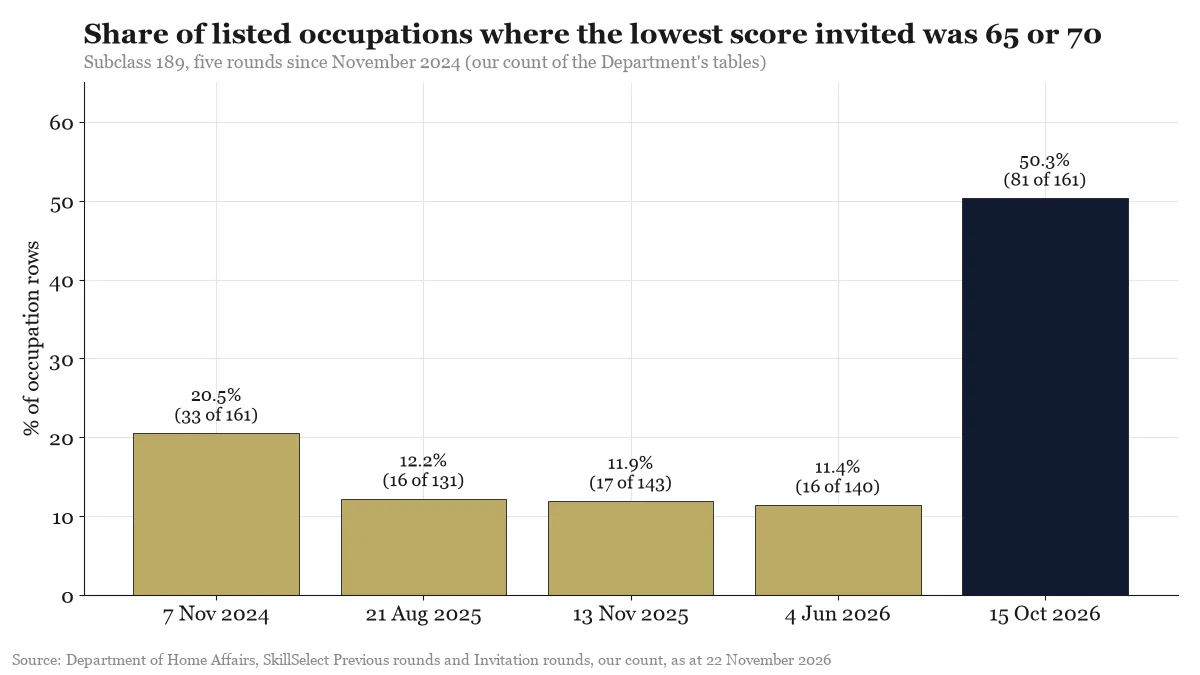
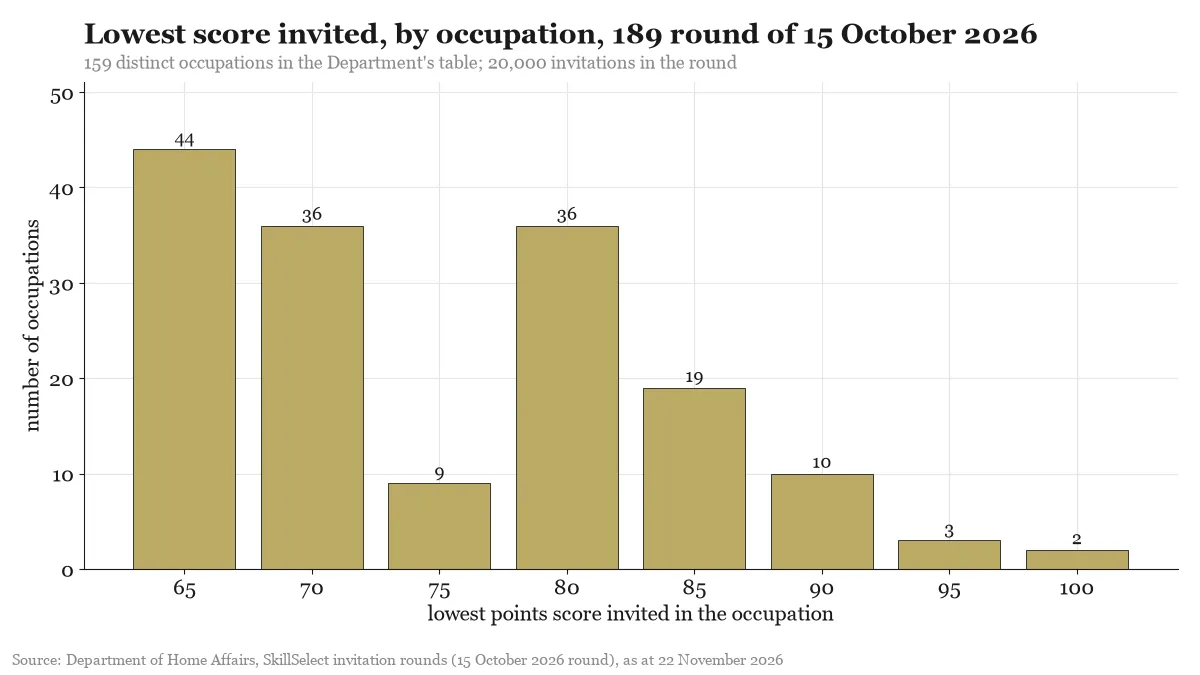
The minimum score invited also moved. In the 15 October round the Department’s table lists 161 occupation rows (two occupations appear twice, so 159 distinct), and the lowest score invited was 65 or 70 in 81 of them. In the four earlier rounds we counted from the same tables, the share at 65 or 70 was between about 11 and 21 per cent. A larger round reaching further down the ranking is one reading of that pattern, but the Department does not say why, and an occupation missing from a table can simply mean no EOIs were available or none met the parameters.
| Occupation (15 October 2026 round) | Lowest score invited | Tie break date |
|---|---|---|
| Electrician (General) | 65 | 18/09/2026 |
| Carpenter | 65 | 21/09/2026 |
| Plumber (General) | 65 | 11/06/2026 |
| Registered Nurse (Medical) | 70 | 19/11/2025 |
| General Practitioner | 70 | 18/11/2025 |
| Secondary School Teacher | 80 | 04/09/2026 |
| Construction Project Manager | 80 | 04/09/2026 |
| Early Childhood (Pre-primary School) Teacher | 90 | 22/07/2026 |
| Electronics Engineer | 95 | 21/11/2025 |
| ICT Security Specialist | 100 | 08/11/2024 |
Source: SkillSelect invitation rounds, “Invitations issued by occupation and minimum score invited”, round of 15 October 2026. A selection of the 161 rows; dates as the Department prints them.
No accountant or software occupation appears in that table. The Department’s footnote says a result “could indicate that no EOIs were available to be invited, or EOIs were available but did not meet parameters to receive an invitation”, so absence from the list tells you nothing about your own chances. The table also shows no Subclass 491 (Family Sponsored) invitations in any month of 2026-27 so far, against 150 in August 2025 and 300 in November 2025.
How many places sit behind the invitations
The Department’s planning levels set the number of places in each category for the program year. The 2026-27 Permanent Migration Program is set at 185,000 places, and the Department says the overall level is unchanged from 2025-26. The Skilled Migration Program has 132,240 of them. Inside that, the Skilled Independent level goes from 16,900 to 21,090 and the State/Territory Nominated level from 33,000 to 35,500. The Regional category, which the Department says includes the Subclass 491, falls from 33,000 to 14,110.
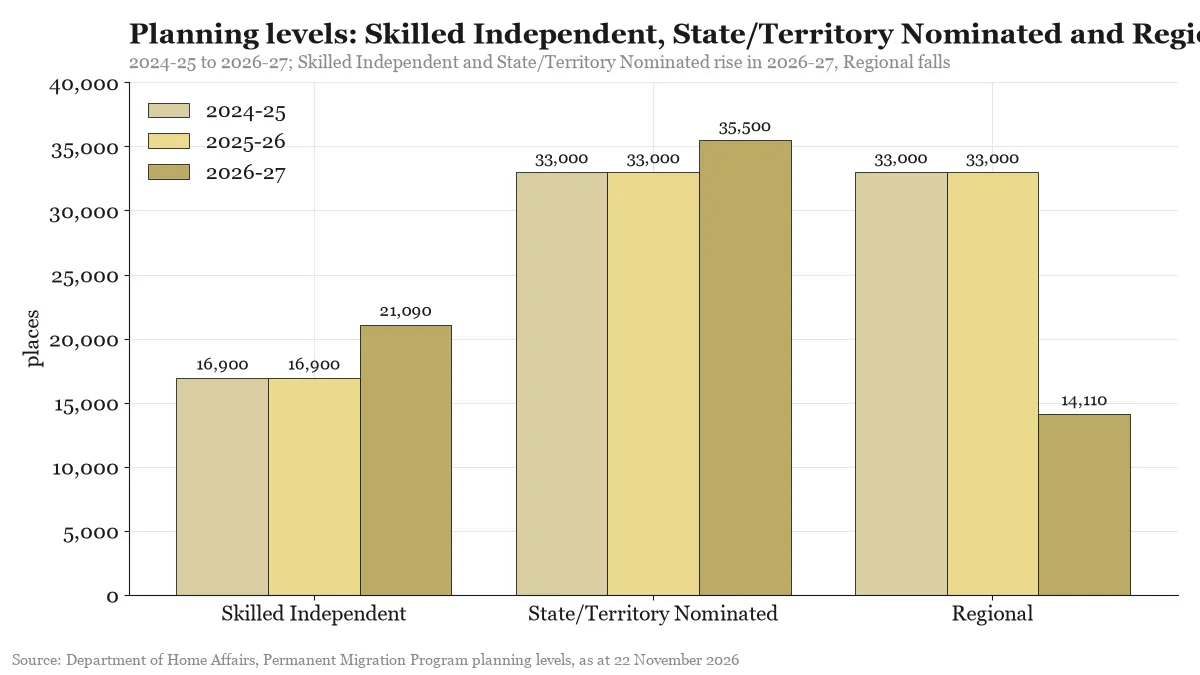
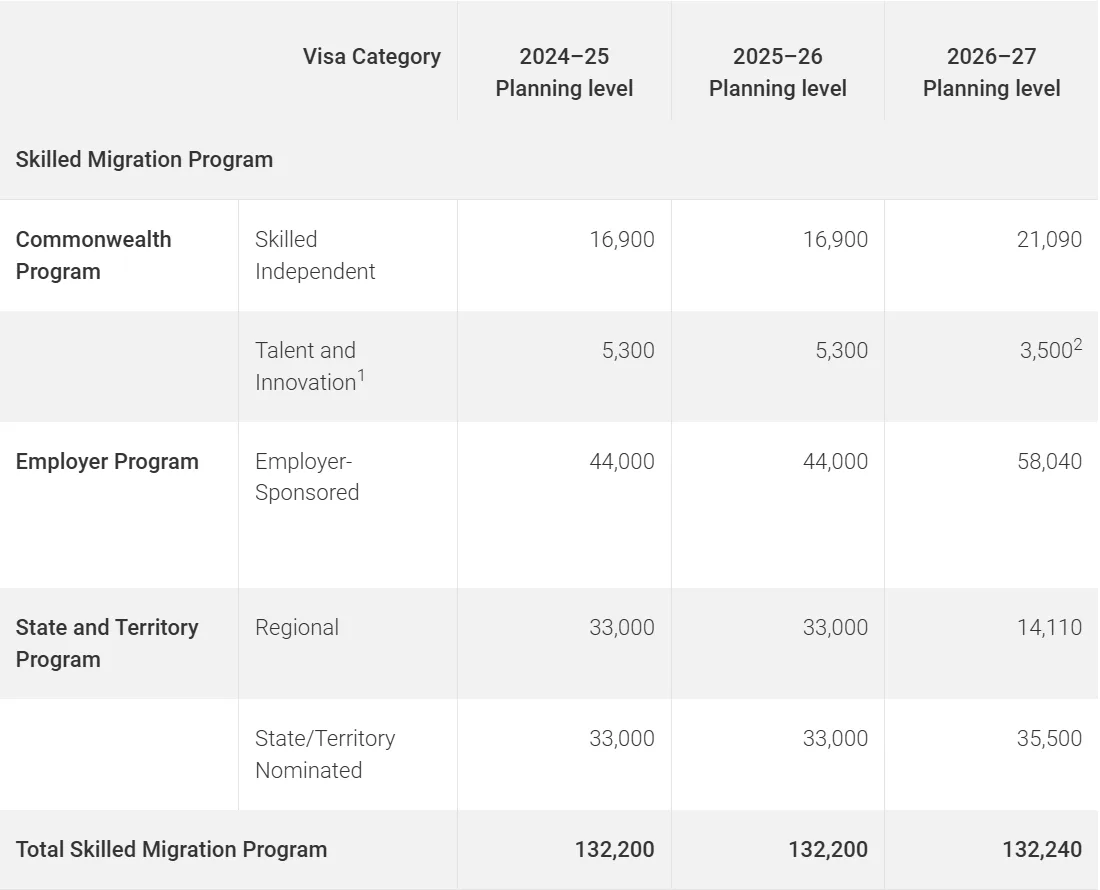
A planning level is not the same as the number of invitations or grants. The 20,000 subclass 189 invitations issued on 15 October 2026 compare with a Skilled Independent planning level of 21,090 places for the year, but not everyone invited applies, and not every application is granted. The Department’s outcome data shows the Skilled stream landing close to its planning level in each of the last two completed years.
| Program year | Skilled planning level | Skilled outcome (places counted) |
|---|---|---|
| 2024-25 | 132,200 | 132,148 |
| 2025-26 | 132,200 | 132,222 |
| 2026-27 | 132,240 | Not yet available |
Source: Permanent Migration Program planning levels (page updated 21 September 2026); BP0068 Permanent Migration Program (Skilled and Family) Outcomes Snapshot, data.gov.au, “Outcome” sheet, Migration Program, Skilled (dataset updated 17 November 2026). The Department defines outcome as “the number of places that count toward the Migration Program ceiling, for example, visas granted that count toward the Program”. The row covers the whole Skilled stream, not only points-tested visas.
State nomination and the Victorian points test
Searches for a “Victorian points test” are looking for something separate from the federal test. The Department’s planning levels page says each jurisdiction “assesses applicants against their own unique criteria”. Victoria publishes its own scoring on its Victorian Points Test page. It ranks every Registration of Interest (ROI) on seven weighted factors, has no fixed pass mark, and states that “the VPT does not have a fixed ‘pass mark'”. The federal rule still applies on top: Victoria’s page says the Australian Government requires all applicants to score at least 65 points. The page carries no date, so we cannot say when the weights last changed.
| Victorian Points Test factor | Points Victoria publishes |
|---|---|
| Age | 300 at ages 20 to 29, falling to 16 at age 44 |
| English language | Competent 0, proficient 100, superior 200 |
| Years of experience in the nominated occupation | 0 under 1 year, up to 100 for 8 years or more |
| Educational qualification | Other 25, bachelor and honours 50, masters 75, PhD 100 |
| Occupation skill level | 50 for a skill level 1 occupation, 0 for levels 2 and 3 |
| Partner’s skill (if applicable) | 50 if the listed conditions are met, otherwise 0 |
| Annual earnings from skilled employment in Victoria | 8 points from $80,000 to $84,999, up to 150 at $170,000 and over |
Source: Live in Melbourne, Victorian Points Test (Victorian Government), read 22 November 2026. The page shows no publication date.
Those maximums add up to 950 (300 + 200 + 100 + 100 + 50 + 50 + 150, our arithmetic), so Victorian scores and federal scores are not comparable. On the 2026-27 program, Victoria’s 26 October 2026 notice says ROIs opened for the Subclass 190 with 900 nomination places, and that places for the Subclass 491 “have not yet been finalised”. Its 13 October 2026 update introduced fees from 2026-27: $60 to submit an ROI (excluding GST) and $180 for a nomination application, the latter payable only if you are invited to apply. Our guide to 190 and 491 processing covers what happens after nomination.
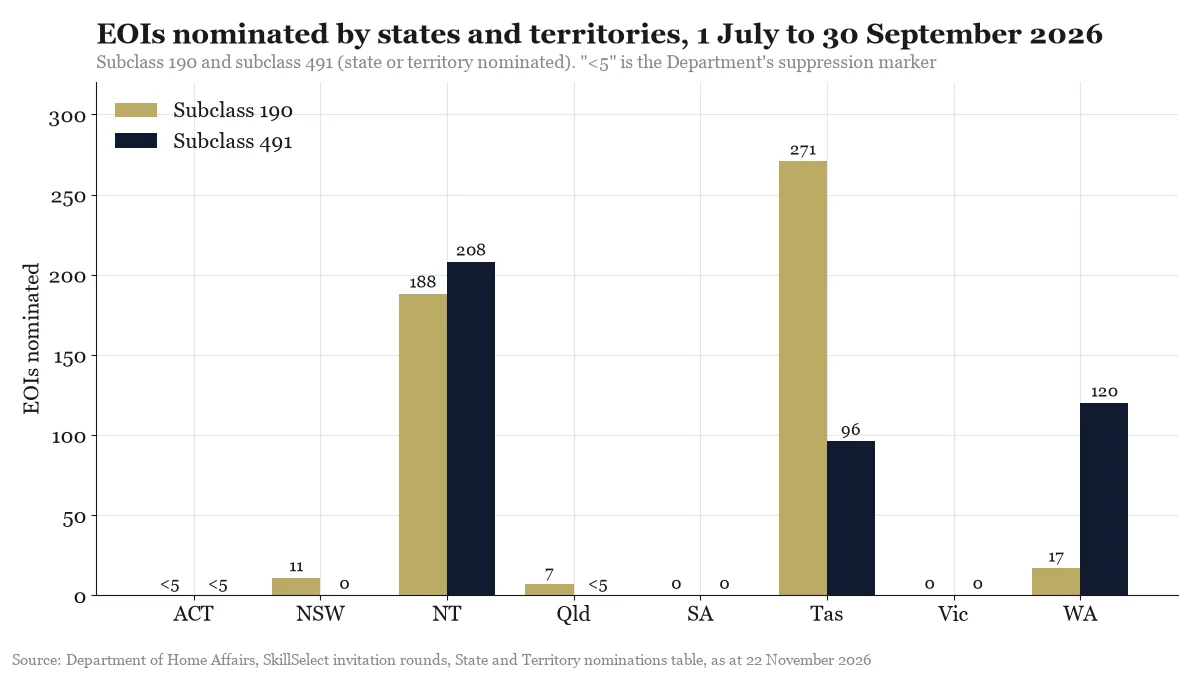
The Department’s table shows how uneven state activity was in the first quarter: the Northern Territory and Tasmania account for most of the Subclass 190 nominations (188 and 271), the Northern Territory, Western Australia and Tasmania for most of the Subclass 491 nominations (208, 120 and 96), and Victoria shows none for either visa. That period ended before Victoria’s 26 October notice said its program was open, so the zero reflects timing and says nothing about Victoria’s later rounds.
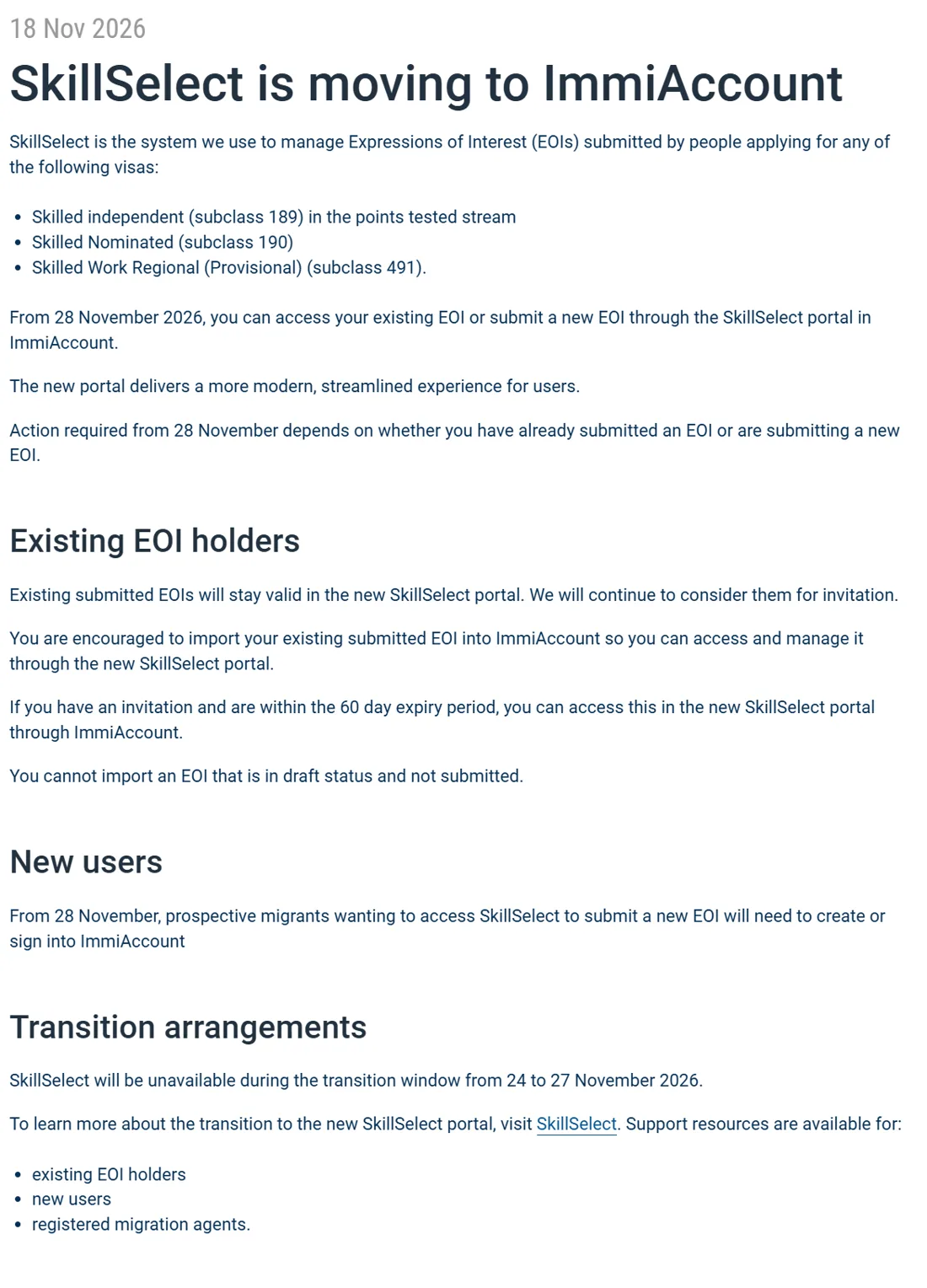
SkillSelect moves into ImmiAccount on 28 November 2026
On 18 November 2026 the Department announced that the SkillSelect portal will be available through ImmiAccount from 28 November 2026. The change covers EOIs for the Subclass 189 (points-tested stream), 190 and 491. The Department’s Accessing SkillSelect page adds: “Accessing SkillSelect through ImmiAccount does not change visa eligibility requirements.” The points table above is untouched by the move.
| Date or situation | What the Department says |
|---|---|
| 24 to 27 November 2026 | SkillSelect is unavailable during the transition window |
| From 28 November 2026 | You access an existing EOI, or submit a new one, through the SkillSelect portal in ImmiAccount |
| Existing submitted EOI | Stays valid and continues to be considered for invitation. You are encouraged to import it into ImmiAccount, and importing early does not affect whether it is considered |
| Draft EOI not submitted | Cannot be imported; you start a new EOI through ImmiAccount |
| Invitation within the 60 day period | Can be accessed in the new portal through ImmiAccount |
| New users | Need to create or sign in to an ImmiAccount to submit an EOI |
Source: SkillSelect is moving to ImmiAccount (18 November 2026) and Accessing SkillSelect (updated 18 November 2026), Department of Home Affairs.
Planning around the law as it stands
Nobody outside Government knows the new numbers, so the points you can work on today are the ones in Schedule 6D. A few situations come up often:
- English. Moving from proficient to superior English is worth 10 more points (items 6D22 and 6D21), and the score is counted at invitation.
- Australian employment. Skilled employment in Australia can earn up to 20 points, against 15 overseas, with the combined cap at 20. Our guide to the post-study work visa covers the period in which many people build it.
- Age. Points step down at 33 and 40, and an applicant must not have turned 45 at invitation, so the date of the invitation is the date that matters.
- State nomination. A Subclass 190 invitation adds 5 points and a Subclass 491 adds 15, but nomination depends on each state’s own criteria. See the 190 visa and 491 visa guides.
- EOIs already lodged. No transitional rules for a new test have been published, so we cannot say whether an announced change would reach an EOI that is already in the pool.
For every other change announced on 17 September 2026 and which of them are law, see our guide to new immigration rules in Australia.
When it is worth getting legal advice
A points score is only the first test. If your score sits near 65 or 70, if a previous visa refusal or cancellation is on your record, if your skills assessment or nominated occupation is uncertain, or if your age is close to a points threshold, the order in which things happen can matter. Our skilled visas team can assess your points score and the pathways open to you, and you can book a consultation with our migration lawyers through our website.
Frequently asked questions
Has the points test changed in 2026?
No. A reform was announced in the 12 May 2026 Budget and described by the Minister on 17 September 2026, but as at 22 November 2026 Schedule 6D and the 65-point pass mark in LIN 19/210 are unchanged, and no start date has been published.
When is the new points system coming to Australia?
No date has been announced. The Minister said housing trades would receive the same points as a university qualification “on implementation”, without saying when that is. A new table would need an amending regulation on the Federal Register of Legislation, and none has been made.
What is the pass mark for PR points in Australia?
It is 65 points for the Subclass 189, 190 and 491, under section 6 of LIN 19/210, for applications made on or after 16 November 2019. Meeting 65 makes you eligible to be in the pool. Invitations in a round go to the highest-ranked EOIs, so the lowest score invited can be higher.
Does Victoria have its own points system?
Yes. Victoria ranks Registrations of Interest with the Victorian Points Test, which has seven weighted factors and no fixed pass mark. It sits on top of the federal requirement, not in place of it. Victoria’s notice of 26 October 2026 said its 2026-27 program was open for the Subclass 190.
How many points do I get for age?
At invitation, 25 points for ages 18 to 24, 30 for 25 to 32, 25 for 33 to 39 and 15 for 40 to 44 (items 6D11 to 6D14). An applicant must not have turned 45 at the time of invitation.
What score do I need for a 189 invitation?
You need at least 65 to be in the pool. In the 15 October 2026 round, the lowest score invited ranged from 65 to 100 depending on the occupation, so check the Department’s results for your own occupation and the round date.
About the author: Tina Nematian is the Principal Lawyer at One Planet Migration Law. She is admitted as an Australian Legal Practitioner, and has guided clients through partner, skilled, employer-sponsored, student, and humanitarian visa applications across Australia.
This article is general information only and does not constitute legal or migration advice. Visa rules change frequently and outcomes depend on individual circumstances. Speak with a registered migration lawyer or agent before making any application. Figures were current as of November 2026; always check immi.homeaffairs.gov.au before lodging.